Anchor & Alpha
A meta-decision framework for high-stakes choices.
Does your current decision look like this?
| Structural Variable | What It Means | Why It's Deadly |
|---|---|---|
| Low reversibility | Can't undo it, or undoing costs too much | Mistakes compound |
| Time delay | Consequences lag 5–10+ years behind | No real-time feedback |
| Information asymmetry | Key facts are hidden or distorted | Systematic misdirection |
| Emotional contamination | Decision point = emotional peak | Least clear-headed when it matters most |
If so, you're probably experiencing this:
- You've been going in circles on this for a while. The more you think, the muddier it gets.
- You've asked many experts. Everyone says something different.
- You've tried everything — books, courses, conversations — but the problem remains.
- You understand your situation better than most people. You've become your own amateur doctor.
- What you lack isn't information. It's a different kind of framework.
Three things you're probably ignoring:
1. Your state is wrong
You're deciding under low energy, anxiety, urgency. In that state, your brain picks the "low-effort" option — not the best one, but the one that avoids confronting the real problem. Every decision model is theater in this state.
2. Your models are biased
Industry experts have valuable experience. But the mental models you use to understand yourself, to define success — those sit beneath any expert advice. Without non-consensus thinking at that layer, you can't fully leverage experts.
3. You're not creating options
If your best option scores 60, your decision can't score higher than 60. Only by creating a 90-point option can your decision quality reach 90. This is the Alpha option. It's hard, and most people skip it.
The key to high-stakes decisions isn't "which one to pick." It's "should I decide now" and "are my options good enough."
Four upstream questions determine the ceiling of your decision quality: Is my state right for this decision? Am I using the right level of thinking framework? Is my information foundation solid? Am I choosing among good options, or compromising among bad ones?
1. Why You Need "Meta-Decisions"
1.1 The Limits of Traditional Decision-Making
The standard playbook: Define problem. List options. Weigh pros and cons. Pick the best.
Three assumptions go unchecked:
| Assumption | The Problem |
|---|---|
| Decision-maker is in the right state | Low energy distorts both thinking and information gathering |
| Option pool already contains the best answer | If the best option is 60/100, the decision can't exceed 60 |
| Analytical framework matches the problem's depth | Using symptom-level thinking on structural problems = guaranteed inefficiency |
1.2 What Is a Meta-Decision?
Meta-Decision = a decision about how to decide.
Before entering the traditional decision process, the meta-decision system asks four upstream questions:
- State Check: How is my current state affecting my thinking?
- Model Match: What level of thinking framework should I use?
- Information Audit: Is my information base sufficient for this decision?
- Option Quality: Am I selecting among good options, or compromising among bad ones?
2. System Architecture: The Decision Hourglass
            ▲ Create better options
           / \
          /   \           Creation Triangle (top)
         /     \          Option quality = decision ceiling
        /_______\
       /         \
  Decision    Decision     ← Shared layer
  Models      Information
       \         /
        \_______/         Constraint Triangle (bottom)
         \     /          State = capability ceiling
          \   /
           \ /
            ▼ Decision State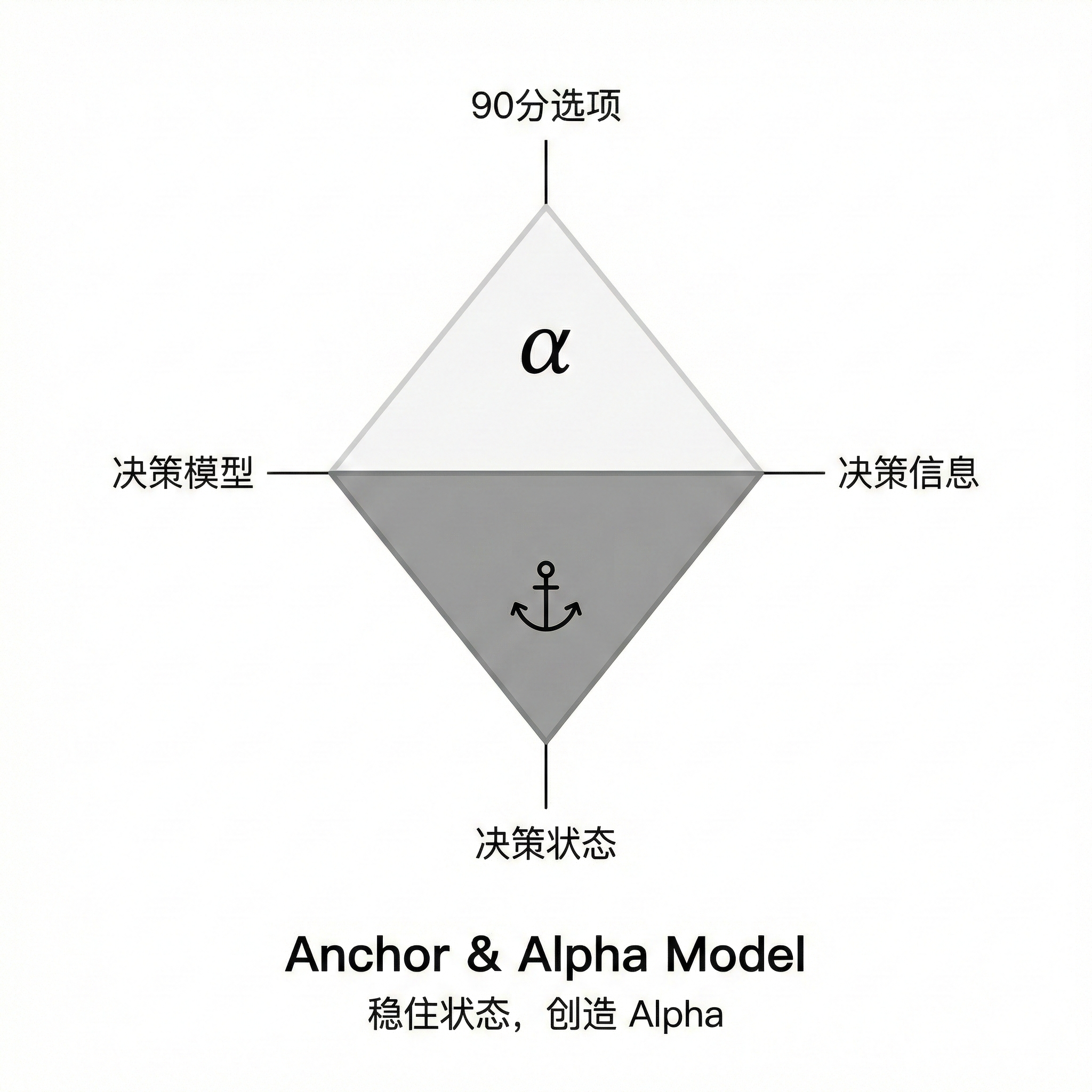
2.1 Constraint Triangle: State Sets the Ceiling
Decision state is the invisible ceiling. Your energy level determines the cognitive resources you can access. Everything above it is constrained.
2.2 Creation Triangle: Option Quality Sets the Upper Bound
No 90-point options, no 90-point decisions. The quality of what you create determines the quality of what you can choose.
2.3 Direction: Bottom Up
The sequence matters:
- Check state
- Select model
- Gather information
- Create options
- Execute
Principle: Confirm your capability boundary before opening the decision process.
3. Subsystem 1: Decision State (5-Gear Energy Model)
| Gear | Keyword | Core State | Impact on Decisions |
|---|---|---|---|
| 1 | Burned out | Your body is forcing a stop | Can only see "quit" and "give up" |
| 2 | Anxious for change | Money to spend, no energy to act | Can see options, but prone to impulse or procrastination |
| 3 | Stable base | Breaking even, holding ground | Can make routine decisions, can't see breakthrough options |
| 4 | Open system | Actively exploring, growing outward | Wide view, can evaluate unconventional options |
| 5 | Facing fear | Confronting the problem you've been avoiding | Can make the decision you've been afraid to make |
Energy doesn't determine whether you can decide. It determines how many options you can see.
4. Subsystem 2: Decision Models (Three-Layer Thinking Framework)
4.1 Framework Structure
When you face a problem, what's your first question?
| Level | First Reaction |
|---|---|
| Beginner | "Which option is better?" |
| L1 Inversion | "Which option would kill me?" |
| L2 Leverage | "Where is the high-leverage intervention point?" |
| L3 Double-Loop | "Is this even the right problem?" |
L1: Inversion Thinking
Core question: How to avoid stupidity.
Source: Charlie Munger — "Invert, always invert."
- Find the system's fatal points
- Find fragility
- Stay away from "too hard" problems
- Build a "don't want" list
L2: Leverage Thinking
Core question: What layer is the root cause on? Where should I intervene?
Source: Donella Meadows' system leverage points
Core paradox: 90% of effort goes to Layer A (most visible, easiest), but 90% of root causes live in Layer C/D (most hidden, most painful to change).
12 System Intervention Points:
| Layer | Leverage Point | What It Is | Diagnostic Signal |
|---|---|---|---|
| D | 1. Transcend paradigms | Recognizing no paradigm is absolute | "This is the only right way" |
| D | 2. Paradigm | Deep beliefs supporting the system | "Everyone does it this way" |
| C | 3. Goals | What the system pursues | "Won the battle, lost the war" |
| C | 4. Self-organization | System's ability to evolve | "I control everything, but there's no vitality" |
| C | 5. Rules | Incentives, penalties, constraints | "The rules force me to do this" |
| B | 6. Information flows | Who knows what, is it corrupted | "I don't know the real situation" |
| B | 7. Reinforcing loops | Snowball effects (good or bad) | "Things are accelerating" |
| B | 8. Balancing loops | Forces pulling system back to baseline | "No matter what I try, I end up back here" |
| B | 9. Time delays | Lag between action and result | "I tried, it didn't work" (How long did you wait?) |
| A | 10. Structure | Physical layout and resource allocation | "Replace me with anyone, same result" |
| A | 11. Buffers | System reserves and margins | "No slack — can't get sick, can't take time off" |
| A | 12. Parameters | Numbers, resources, effort level | "I need to try harder / get more resources" |
Commute Analogy:
| Layer | Intervention | Commute Analogy |
|---|---|---|
| A | Parameters / Buffers / Structure | Floor it, keep a full tank, buy a better car — easy but limited |
| B | Information / Loops / Delays | Use GPS, avoid rush hour, understand red lights — smarter than flooring it |
| C | Rules / Self-org / Goals | Move closer, negotiate flex hours — change the rules, problem disappears |
| D | Paradigm / Transcend | Why commute at all? Remote work. Why this job? — put on different glasses |
Escalation path:
Layer A fails → Layer B: Is the feedback right? Is the info accurate? Did you wait long enough?
Layer B fails → Layer C: Are the rules and goals right?
Layer C won't budge → Layer D: What deep belief is locking all of this in place?
L3: Double-Loop Reflection
Core question: Am I solving the right problem? Do the premises hold?
Source: Chris Argyris' double-loop learning
- What problem am I actually solving? Wrong question?
- What are the hidden assumptions? Are they true?
- What values am I using to decide, especially in conflicts?
- What does success actually look like? Is that real?
Sequence: L1 (survive) → L2 (find leverage) → L3 (challenge premises)
5. Subsystem 3: Decision Information (Three-Layer Information Architecture)
L1: Base Rates & Negative Lists (External Anchoring)
Core question: What do external data tell me? Which paths are proven dead ends?
Core paradox: You need to know the baseline rules to have any chance of creating your own exceptions.
Base Rate operations: Historical success rate distributions, repeatedly validated patterns, typical outcomes in similar situations, statistical data as anchor regardless of subjective feelings.
Negative List operations: Collect known failure modes, identify paths predecessors proved don't work, mark as "excluded."
Output: Objective lower bound of the decision.
L2: Bias Detection
Core question: What's distorting the "truth" you see?
Core paradox: You think you're thinking independently. You're actually singing in a choir.
Three Distortion Fields:
| Bias Source | How It Works | Typical Signal |
|---|---|---|
| Self-bias | Conclusion first, evidence second (confirmation bias) | "I knew it" / only reading supporting views |
| Social media bias | Algorithm echo chambers amplify extremes | "Everyone online says..." / mistaking traffic for consensus |
| Authority bias | Expert opinions override independent judgment | "So-and-so said..." / never asking about the expert's incentives |
GPS analogy: You think you're driving (deciding independently). Actually you're following navigation (guided by information sources). If the map data is corrupted, you'll drive into a ditch thinking you're on the optimal route.
- Source check: Where did this info originate? How many times was it retold?
- Interest lens: What's the messenger's position? Who benefits from me believing this?
- Reverse search: Actively search "why X is wrong" — only trust if you can't find strong counter-arguments.
- Silent evidence: What perspectives are missing from my information flow? Where are the losers' voices?
Output: De-contaminated information base — distinguishing "what I know" from "what I've been fed."
L3: Variable Decomposition
Core question: What variables determine this decision? What's your cognitive status on each?
Medical checkup analogy:
- Known zone: You know you have high blood pressure, monitoring regularly
- Known unknowns: You know you should check cholesterol, but haven't yet
- Unknown unknowns: Doctor says you need a test you've never heard of
- Avoidance zone: Your chest occasionally hurts, but you don't want to check — afraid it's your heart
The avoidance zone often hides the highest-leverage variables — you avoid it precisely because you sense it matters. You avoid it because facing it means real change.
Dimension 1: Leverage Level
| Layer | Variable Type | Content Creator Example |
|---|---|---|
| D/C | Systemic | Writing system (can you produce consistently?) |
| B | Structural | Publishing frequency (is the information flow stable?) |
| A | Surface | Individual piece quality (is this one good enough?) |
Dimension 2: Cognitive Status
| Quadrant | Definition | Diagnostic Question | Risk |
|---|---|---|---|
| Known | Confirmed, no more research needed | "Which variables are you certain about?" | May be false certainty (overconfidence) |
| Known unknowns | Know you don't know, need research | "Which variables need investigation?" | At least you know what to ask |
| Unknown unknowns | Don't know what you don't know | "Has any expert pointed out variables you never considered?" | Most dangerous — blind spot |
| Avoidance zone | Know but don't want to face | "Which variables do you know about but prefer not to confront?" | Self-deception — often the key leverage point |
Test: If your avoidance zone is empty, you're probably deceiving yourself.
6. Subsystem 4: Creating Options (Three-Layer Creation Framework)
Good options aren't "thought up" — they're grown. Not compromise. The elimination of compromise.
Prerequisite — Lock the Boundaries: What is absolutely non-negotiable? (List 3)
- Cannot cause irreversible financial damage
- Cannot harm core relationships
- Must preserve an exit path
Constraints aren't the enemy of creativity. They're the focusing lens. Infinite possibility = decision paralysis.
L1: Orthogonal Recombination
Core question: Do my options come from different dimensions?
Core insight: 100 variations of the same idea = 1 option.
Portfolio analogy: 10 tech stocks is not diversification. Stocks + gold + real estate = real hedging.
- Homogeneity check: Do existing options "look alike"?
- Dimension listing: What completely different angles exist?
- Forced hybridization: Take elements from different dimensions, combine into new options.
Test: New options should feel "a bit strange." If they feel natural, they're probably old ideas in disguise.
L2: Tension Resolution
Core question: Is this "either/or" real, or an illusion from not decomposing variables far enough?
Core insight: The hallmark of a 90-point option is "both/and." Still compromising = haven't decomposed enough.
Example — Deep Work vs. Team Collaboration:
- Surface conflict: Focus requires isolation. Collaboration requires availability.
- Decompose: Collaboration = synchronous + asynchronous. Focus = uninterrupted time blocks.
- New structure: Default to async collaboration + fixed sync windows. Result: deep work output actually improves collaboration value.
- Write the conflict: X vs Y
- Decompose: What sub-variables make up X? Y?
- Recombine: Any new arrangements among sub-variables?
- Find the flip: In the new structure, could X actually drive Y?
Test: If you're still "balancing" two things, you haven't decomposed far enough.
L3: Rule Reframing
Common mistake: Focusing on "solving the problem."
Non-consensus insight: The highest-level option isn't scoring high in the current game — it's redefining the game. Not solving the problem, but dissolving it — making it irrelevant.
- Move up one level: Why am I solving this problem?
- Lateral shift: Is there a completely different path to the underlying goal?
- Rule audit: If I could change one rule, would the problem disappear?
Examples: "How to build a faster horse?" → Build a railroad. "How to buy a house in this city?" → Question the premise of needing to settle.
Creation sequence: Hybridize (L1) → Eliminate conflict (L2) → Dissolve the problem (L3)
7. System Integration: Fractal Structure
All four subsystems follow a unified logic:
L1 Exclude → L2 Structure → L3 Transcend
Each layer narrows the space differently. L1 removes what kills you. L2 finds the structural lever. L3 questions whether the game itself is the right one. The same pattern repeats at every scale.
8. When to Use This (and When Not To)
Use it when:
- High stakes, complex, irreversible, and you have time to think
- Career choices, investment decisions, startup direction
- Major life decisions, strategic planning
Don't use it when:
- Emergencies requiring immediate response
- Low-stakes decisions
- Situations with zero available information
9. Closing
The core value of the meta-decision system isn't providing the "right answer." It's a structured thinking framework that ensures you:
- Decide in the right state
- Analyze at the right depth
- Build on quality information, not gut preference
- Create better options instead of compromising among mediocre ones
Appendix: Glossary
| Term | Definition |
|---|---|
| Meta-decision | A decision about how to decide; examining decision conditions before deciding |
| Decision state | Current level of available cognitive resources |
| Leverage solution | Intervention at the root cause layer, not the symptom layer |
| Double-loop reflection | Questioning the goals and premises themselves |
| Base rate | Historical statistical probability of a specific type of event |
| Non-consensus insight | A unique perspective that differs from market consensus |
| Orthogonal recombination | Cross-domain combination of elements from unrelated dimensions |
| Tension resolution | Finding a structure that eliminates apparent conflicts between goals |
| Problem dissolution | Making the problem itself irrelevant, rather than solving it |
High-stakes decisions deserve serious protection.
Consulting available in Mandarin.